

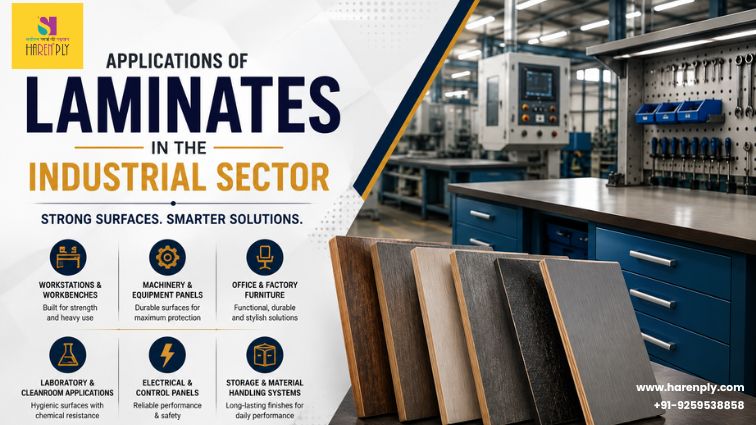
The reason why laminates are extensively used in the industrial setting is that laminates exhibit all the characteristics mentioned above, such as strength, surface protection, resistance to chemicals, and flexibility in design. Laminates can be found in factory interiors, workstations, machine panels, and storage systems.
At Haren Ply, as a laminate manufacturer, we understand that industries look for materials that offer long service life with minimal maintenance. As a result, high-performance laminates have become an important choice across multiple applications.
Key Industrial Applications of Laminates
- Industrial Workstations and Workbenches
The surfaces of industrial workstations must be resistant to heavy usage, scratching, impacts, and exposure to oils and chemicals. Laminates provide a durable surface for workstations, assembly tables, and technical benches that is easy to clean and maintain.
- Machinery and Equipment Panels
Uses of laminates include machine paneling, control cabinetry, machinery enclosures, and protection surfaces. The hard-wearing surface ensures durability of appearance and protects against day-to-day industrial wear and tear.
- Office and Factory Furniture
In an industrial setting, there is a need for functional and robust furniture. Furniture laminates are applied to items such as desks, cabinets, storage systems, partitions, and other office furniture. The wide array of finishes is useful for creating a professional work environment.
- Laboratory and Cleanroom Applications
Specialized laminates are appropriate for places where cleanliness and chemical resistance are critical. These laminates can be used on laboratory benches, cabinets, countertops, and other surfaces that need to be regularly cleaned and offer resistance to common chemicals.
- Electrical and Control Panels
Laminates may be employed in electrical and control panel applications that require specific insulating and surface characteristics. Based on the application, laminate suppliers may choose the laminate grade based on electrical, mechanical, thermal, and environmental criteria.
- Storage and Material Handling Systems
Industrial storage units are subject to continuous handling and wear due to their operations. Laminates can be applied as a finish for cabinets, shelves, counters, and storage furniture.
Why Industries Choose Laminates?
The suitability of laminates for industrial applications comes from a combination of performance and practicality:
- High surface durability: Helps withstand everyday abrasion, scratches, and impact.
- Easy maintenance: Smooth surfaces can be cleaned without complex maintenance procedures.
- Resistance to chemicals: Certain types of laminates can offer resistance to specific chemicals and industrial materials.
- Design flexibility: Comes in various colors, designs, textures, and finishes.
- Economical choice: Provides a long-lasting surface finish without requiring the high maintenance associated with many conventional materials.
- Multiple uses: Can be used for furniture, panels, workstations, labs, and interiors.
Choosing the Right Laminate for Industrial Use
Different industrial applications have different demands. Some of the aspects that should be considered include the material’s resistance to abrasion, impact, chemicals, temperature, humidity, hygiene requirements, and intended use. It is very important to note that selecting the right type of laminate grade and substrate can make a big difference.
This is where experienced manufacturers of laminates, for example, Haren Ply, can play a crucial role. Manufacturers who understand the demands of industrial environments can assist companies in choosing the right laminate solutions.
Best Laminate Manufacturer – Haren Ply
Haren Ply’s approach involves concentrating on providing laminate options based on strength, functionality, and current surface needs. The applications include everything from furniture and workspaces to interior panels. The right choice of laminate can help any business strike a balance between performance, aesthetics, and durability.
When industries are considering the construction of new facilities or improving their current workspaces, choosing the right laminate manufacturer during the initial design phase can be beneficial.

