
Haren Ply

Author name: Harenply

Plywood Sheets for Different Interior Applications
Plywood

How to Choose Plywood Sheets for Different Interior Applications

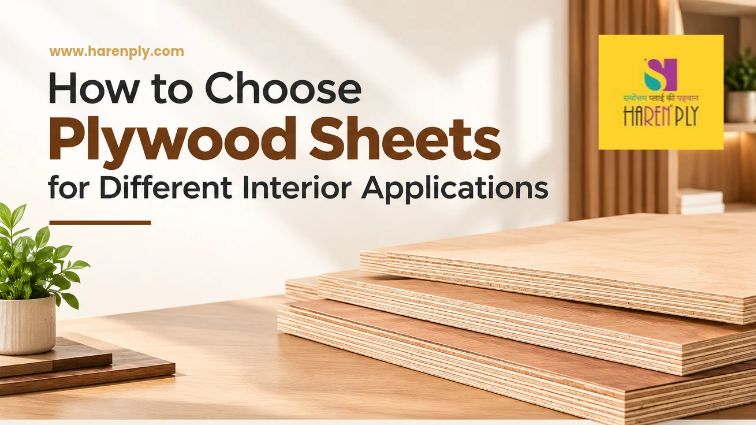
The choice of plywood for use in construction is very important to ensure that you get lasting and beautiful interiors. This is because the different rooms in your house are exposed to different levels of moisture, weight, weathering, and temperatures. Thus, one should select plywood according to its use. For buyers comparing Plywood Sheet Manufacturers in India, we at Haren Ply help you to understand plywood grades, thickness, and performance characteristics to ensure the right material is specified for every interior requirement. Plywood Selection Based on Interior Application: Interior Application Recommended Plywood Key Selection Factor Kitchen Cabinets BWP / Marine Plywood Moisture and water resistance Wardrobes MR / BWR Plywood Dimensional stability Furniture Calibrated / Structural Plywood Strength and surface quality Bathroom Vanities BWP Plywood High moisture resistance Doors & Partitions BWR / Structural Plywood Strength and stability Office Furniture Commercial / BWR Plywood Load-bearing performance 1. Kitchen Cabinets and Units: Kitchen surfaces are exposed to humidity, water splashing, and usage. Hence, BWP (marine grade) plywood is usually preferred for places with more moisture content. The ideal ply will provide good bonding, dimensional stability, and be resistant to delamination. 2. Wardrobes and Bedroom Furniture: Wardrobe panels have low moisture but good screw-holding capability and dimensional stability. Either MR or BWR plywood is suitable based on the environment inside the room. It should also suit the size and weight of the shelves, shutters, and carcasses. 3. Living Room Furniture: The furniture, such as a sofa set, cabinet, and television unit, should have strength from plywood, and at the same time its surface should be good enough to allow lamination. Calibrated plywood would be very helpful where accurate thickness is needed for manufacturing furniture. 4. Bathroom and Utility Areas: High moisture environments require enhanced moisture resistance. BWP plywood is recommended for bathroom vanities and utility cabinets as its bonding system provides increased resistance against moisture compared to normal interior grade plywood. 5. Doors, Partitions and Office Interiors: The stresses imposed on the door and partition, as well as their dimensional stability, dictate the need for materials that can withstand these stresses. For commercial interior doors, plywood is the material that needs to be selected based on the load requirement and mounting method. What to Check Before Buying Plywood? Before purchasing from Plywood Suppliers, evaluate: Grading: Correlate the grading of MR, BWR, or BWP with its susceptibility to moisture. Thickness: Should be selected based on structural and design requirements. Layering of the core structure: Layering is critical for performance. Adhesive strength: Strong adhesion will minimize the risks of delamination. Surface quality: An important factor for veneered and laminated boards. Certifications: Ensure the quality standards are met. Conclusion: Choosing the correct plywood will have an impact on the longevity and finishing of any interior work. The renowned Plywood Sheet Manufacturers such as Haren Ply are primarily concerned about uniformity in construction, dependable adhesion, and product performance suitable for various applications. If you want plywood for your furniture, kitchen, wardrobe, or any interior work, the correct choice of grade and thickness is critical. Frequently Asked Questions: Which type of plywood is best for interior design? BWP and MR-grade plywood are popular choices, depending on the room’s moisture exposure and application. Which type of plywood is best for interior walls? MR-grade plywood is generally suitable for interior wall paneling in dry indoor areas. What are the 5 grades of plywood in India? Common classifications include MR, BWR, BWP, Marine, and structural-grade plywood Which ply is most waterproof? BWP (Boiling Waterproof) plywood offers excellent water resistance and is suitable for moisture-prone areas.


Plywood Brands in India
Plywood

How to Compare Plywood Brands in India Before Making a Purchase

Plywood selection is not merely an exercise in price comparison or choosing a favourite brand. The right choice of plywood affects the strength, durability, moisture resistance, and service life of furniture and other applications. In India, where many plywood brands are available, Haren Ply helps buyers understand and evaluate product specifications so they can make informed decisions. 1. Check the Plywood Grade and Application To begin, identify where you intend to use the plywood. Commercial-grade plywood may be suitable for certain furniture applications, while BWP (Boiling Water Proof) plywood or suitable marine-grade plywood may be considered for applications involving higher moisture exposure. Always check the product’s stated grade and specifications before making a selection. Consider: Interior furniture and partitions Kitchen and bathroom applications Doors and heavy-duty furniture Commercial and high-humidity environments The plywood grade should match the actual conditions of use rather than being selected solely on price. 2. Evaluate Core Construction and Strength A reliable plywood manufacturer pays close attention to veneer uniformity, layering, adhesive bonding, and pressing. Check the core structure, veneer thickness, number of plies, density, and surface uniformity. A well-constructed panel should have: Consistent thickness Minimal core gaps and overlaps Uniform veneer arrangement Good screw-holding capacity Resistance to bending and delamination appropriate to its intended use These factors can directly affect the panel’s long-term performance. 3. Compare Adhesive Bonding and Moisture Resistance Adhesive bonding quality is one of the key factors that differentiates plywood products. Buyers should verify that the adhesive system and plywood grade are suitable for the expected moisture conditions. Do not assume that a product is water-resistant based on its name alone. Check the applicable testing standards and the manufacturer’s substantiated product claims. 4. Verify Quality Standards and Certifications When comparing the various plywood brands in India, documentation can provide more assurance than marketing claims alone. Look for relevant BIS standards, applicable ISI markings, certifications, and manufacturer test results. Also check the consistency of the manufacturer’s production processes and quality control across different batches. 5. Consider Price vs. Long-Term Value The most affordable plywood is not necessarily the best buy. Early delamination, warping, screw-retention problems, or frequent replacement can increase total project costs. Instead, compare the following: Parameter What to Check Grade Suitability for the intended application Core Gaps, uniformity, and construction Bonding Adhesive quality and durability Thickness Dimensional consistency Certification Applicable standards and documentation Price Cost compared with expected service life Conclusion The characteristics of a reliable Plywood Manufacturer include clearly stated specifications, transparent product information, consistent quality management, and technical support. Haren Ply is committed to producing plywood products designed to meet the requirements of residential, commercial, and interior applications. To choose the Best Plywood Company in India, evaluate relevant quality parameters rather than relying only on brand popularity. Selecting plywood that suits the intended application can help deliver better durability and performance. Frequently Asked Questions What criteria should I use to select the plywood that is best for me? Compare the grade, core construction, adhesive bonding, thickness, certifications, moisture resistance, and expected service life of the plywood. What qualities should I consider when choosing a trustworthy plywood manufacturer? Check the manufacturer’s quality certifications, product specifications, consistency of manufacturing, and ability to provide technical information about its products. Does expensive plywood mean good plywood? No. Select plywood based on its properties, verified specifications, and suitability for the intended application—not on price alone. Which plywood should I use in moisture-prone areas? BWP-grade or appropriately specified marine plywood may be suitable for kitchens, bathrooms, and other moisture-prone areas. Check the product specifications and ensure proper installation and edge protection.

Construction Projects That Need Shuttering Plywood
Shuttering Plywood

Construction Projects That Need Shuttering Plywood

The strength and quality of concrete construction depend significantly on the quality of the formwork used during the construction process. From tall buildings and bridges to houses and other structures, quality formwork materials are required to hold fresh concrete and help create smooth and properly shaped concrete structures. This is where Shuttering Plywood in Uttar Pradesh plays an important role. Shuttering plywood is specially used for formwork applications in concrete construction. It helps create temporary moulds that support and contain fresh concrete until it gains sufficient strength. Construction Projects That Need Shuttering Plywood 1. Residential Construction Projects Shuttering plywood is widely used in the construction of houses, apartments, villas, and residential complexes. It can be used for formwork applications involving concrete elements such as: Columns and beams Roof slabs Staircases Foundations Walls Quality shuttering plywood can help concrete achieve the desired shape while providing suitable support during concrete placement. 2. Commercial and High-Rise Buildings Commercial complexes, office buildings, shopping centers, and high-rise towers often involve large-scale and repetitive concrete work. Contractors require formwork materials that can provide consistent performance across multiple applications. Durable shuttering plywood can help construction teams maintain consistency across different floors and structural components. Its ability to provide a smooth formwork surface can also contribute to a better concrete finish and may reduce additional surface preparation. 3. Infrastructure and Government Projects Major infrastructure projects require dependable formwork materials that can perform under demanding construction conditions. Shuttering plywood is commonly used for formwork applications in projects such as: Flyovers and bridges Metro and railway structures Roads and drainage systems Government buildings Public infrastructure For these projects, selecting the right Shuttering Plywood in Uttar Pradesh can help maintain consistent formwork performance and support efficient construction operations. 4. Industrial Buildings and Warehouses Factories, manufacturing units, warehouses, and other industrial facilities often involve concrete foundations, floors, columns, and structural elements. Strong shuttering plywood can help contractors manage these formwork applications efficiently. Since industrial projects may involve repetitive formwork, durable and reusable plywood can also help increase the number of potential reuse cycles, depending on handling, application, and site conditions. 5. Large-Scale Real Estate Developments Townships, apartment complexes, and other large-scale residential developments involve repetitive concrete construction across multiple structures and phases. Shuttering material is required to create consistent formwork for different stages of construction. Good-quality shuttering plywood can support efficient formwork cycles and help contractors maintain project schedules. Why Choose Quality Shuttering Plywood? Choosing the right shuttering plywood can contribute to: Better concrete surface finish Strong and stable formwork Improved reusability Reduced material wastage Efficient construction operations Better long-term project value The actual performance and number of reuse cycles can depend on factors such as plywood quality, formwork design, handling, storage, application practices, and site conditions. Choose Haren Ply for Reliable Construction Solutions At Haren Ply, we understand the importance of reliable materials in construction applications where formwork needs to withstand the demands of fresh concrete placement. Our product portfolio includes Shuttering Ply, supporting construction and formwork requirements. Quality-focused manufacturing and consistent product performance can help construction companies, contractors, and builders make more informed choices for their formwork applications. If you are searching for quality Shuttering Plywood in Uttar Pradesh, consider Haren Ply for your construction and formwork requirements.

Identify Authentic Waterproof Plywood
Waterproof Plywood

How to Identify Authentic Waterproof Plywood

Choosing the right type of plywood is essential to ensure long-lasting performance. There are many plywood products available in the market, and it can sometimes be difficult to differentiate between genuine waterproof plywood and products that may look similar. Different plywood products can vary in their bonding strength, water resistance, core quality, and overall performance. Whether you are a homeowner, interior designer, builder, contractor, or furniture maker, it is important to understand how to identify quality waterproof plywood before making a purchase. It is also important to choose products from reliable Top Waterproof Plywood Manufacturers in India, such as Haren Ply, and understand the key factors that can help you identify genuine waterproof plywood. Factors to Identify Authentic Waterproof Plywood 1. Check the Plywood Grade The first step is to verify the grade mentioned on the plywood sheet and its product documentation. Waterproof plywood is designed to provide better resistance to moisture than standard plywood, making the appropriate grade an important consideration for areas where moisture exposure is expected. Before purchasing plywood, always check the grade and product specifications. Reputed Waterproof Plywood Manufacturers in India provide relevant product information to help buyers make an informed decision. 2. Examine the Bonding Quality The bonding quality between veneer layers plays an important role in determining how well plywood performs when exposed to moisture. Carefully inspect the edges of the plywood sheet. Quality waterproof plywood should have: Strongly bonded veneer layers No visible gaps between the layers Minimal signs of peeling or delamination A uniform and well-pressed structure Poor bonding can allow moisture to enter between the layers, which may eventually cause the plywood to swell, separate, or delaminate. 3. Perform a Simple Water Resistance Check A basic water-resistance check can provide useful insights into how plywood reacts to moisture. However, a simple water test should only be treated as an initial observation and not as a substitute for professional testing, product specifications, or applicable certifications. When checking the plywood, look for signs such as: Swelling around the edges Separation of veneer layers Surface bubbling Changes in shape or warping Quality waterproof plywood is manufactured using appropriate adhesives and bonding processes to provide better resistance against moisture exposure. For a more reliable assessment, buyers should also check the manufacturer’s product specifications and applicable quality certifications. 4. Check the Surface and Core Quality The outer surface is not the only factor that determines plywood quality. The core construction is equally important. Good-quality plywood should have a uniform structure without visible gaps, overlaps, or weak spots in the core. The surface should also be smooth and properly finished. A well-constructed core can contribute to the plywood’s durability and screw-holding performance, depending on the product and its intended application. Therefore, buyers should inspect both the surface and core before making their final selection. 5. Verify Manufacturer Details and Certifications Always consider purchasing plywood from an established manufacturer or an authorized dealer. Check the product for important details such as: Manufacturer’s name and brand Product specifications Quality certifications, where applicable Proper labeling and identification marks Warranty or product assurance, where applicable Authentic products from trusted Waterproof Plywood Manufacturers in India provide greater confidence regarding material quality, manufacturing standards, and product information. Buyer-Friendly Authenticity Checklist Before purchasing waterproof plywood, use this quick checklist to make a more informed decision: Check the grade: Confirm that the plywood grade is clearly mentioned. Inspect the edges: Look for strong bonding and closely pressed veneer layers. Identify any gaps: Avoid plywood with visible gaps, overlaps, or weak spots in the core. Ensure the surface quality: Make sure that the plywood has a smooth and properly finished surface. Check the product details: Verify the manufacturer, product specifications, dimensions, labeling, and other relevant details. Check certifications: Where applicable, verify relevant quality certifications and product documentation. Best Waterproof Plywood Manufacturers in India – Haren Ply Selecting genuine waterproof plywood requires careful consideration of the plywood grade, bonding quality, core construction, water resistance, product specifications, and the credibility of the plywood manufacturer. Choosing the right plywood can help improve the performance and durability of furniture and interior applications. At Haren Ply, we focus on quality, durability, innovation, and customer trust. Haren Ply’s official company material highlights its commitment to quality standards, reliable plywood solutions, innovation, and transparent customer communication. When selecting plywood for your furniture or interior project, consider the application, product specifications, and manufacturer’s credibility before making your decision. Choose quality. Choose confidence. Choose Haren Ply.

Calibrated Ply Vs Normal Ply
Plywood

Calibrated Ply Vs Normal Ply

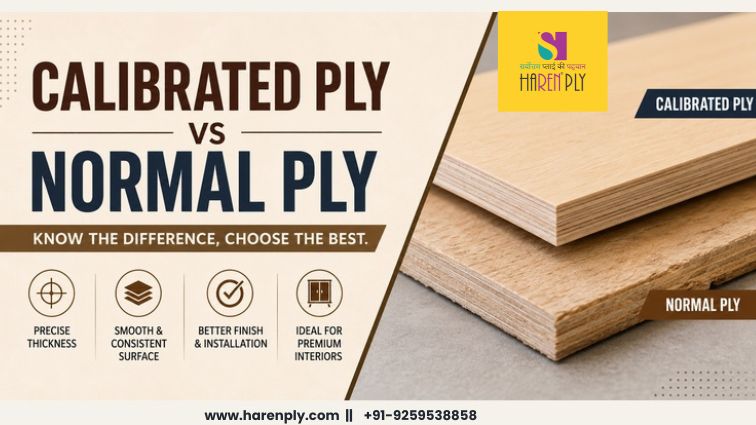
Plywood selection is significant to ensure smoothness, stability and longevity of the wood. Although normal plywood is suitable for various applications, calibrated plywood is more accurate when thickness and surface uniformity are essential. At Haren Ply, which is one of the plywood manufacturers in India, we can assist you in comprehending the difference that can benefit homeowners, architects, interior designers and contractors. What Is Calibrated Ply? Calibrated plywood is manufactured with an additional accuracy sanding process on both surfaces. This process ensures that the plywood sheet maintains a more uniform and consistent thickness across its entire area. The key advantages include: Consistency of Thickness: The calibration process ensures that there is very little variation between sheets of wood. Smooth surface: It provides a uniform surface, which is best suited for laminating and veneering. Better joint work and installations: This will improve joint making and the installation process. Enhanced finish: It is easy to apply finishes to furniture pieces and interiors. Ideal for modular furniture: It is particularly ideal for manufacturing cabinets and wardrobes. In instances when precise measurement and good finishing are a must, calibrated ply becomes the material of choice. What Is Normal Ply? Normal plywood is made by bonding multiple layers of wood veneers under controlled pressure and temperature. It is available in different grades and thicknesses for residential, commercial and industrial applications. Depending on its grade and quality, normal plywood can provide good strength, durability and resistance to everyday use. It is commonly used for furniture, partitions, doors, paneling and general construction requirements. However, conventional plywood may have slight variations in thickness and surface uniformity. The suitability of normal ply therefore depends on the application, grade and manufacturing quality. Difference Between Calibrated Ply Vs Normal Ply Features Calibrated Ply Normal Ply Thickness Highly uniform May have minor variations Surface Smooth & consistent Depends on grade & finish Accuracy Higher dimensional accuracy Standard accuracy Finishing Excellent for laminates & veneers Suitable for general finishes Applications Modular furniture & premium interiors General furniture & construction Cost Generally higher Usually more economical The primary difference is accuracy. Calibrated plywood undergoes controlled sanding to ensure consistent thickness, making it better suited for applications where precise dimensions and a premium finish are essential. Which One Is Better? Neither option is universally better; the right choice depends on the project. Choose calibrated ply when you need: Precise dimensions for modular furniture Consistent thickness across panels A smooth base for laminates or veneers Better alignment between adjoining components A premium-quality interior finish Normal plywood can be a practical choice when the application is less dependent on precision, and the project requires a cost-effective material for general furniture or construction. For premium interiors and precision furniture, calibrated plywood generally offers greater advantages in finishing and installation. Best Ply Manufacturers in India – Haren Ply: Whether you choose to use calibrated ply or ordinary ply depends on the needs of your project. Calibrated plywood from Haren Ply is a perfect material for making accurate furniture as well as luxurious interior designs due to its even thickness and surface. Using plywood from the best plywood Company in India and reputable Calibrated Plywood Manufacturers would be your best bet.

Applications of Laminates
Laminate

Applications of Laminates in the Industrial Sector

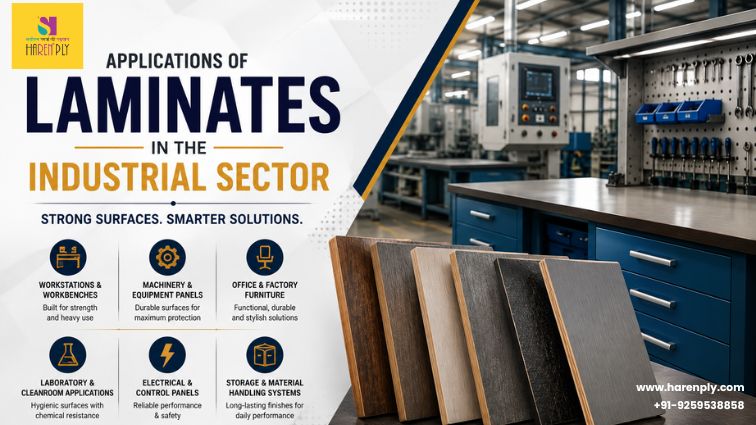
The reason why laminates are extensively used in the industrial setting is that laminates exhibit all the characteristics mentioned above, such as strength, surface protection, resistance to chemicals, and flexibility in design. Laminates can be found in factory interiors, workstations, machine panels, and storage systems. At Haren Ply, as a laminate manufacturer, we understand that industries look for materials that offer long service life with minimal maintenance. As a result, high-performance laminates have become an important choice across multiple applications. Key Industrial Applications of Laminates Industrial Workstations and Workbenches The surfaces of industrial workstations must be resistant to heavy usage, scratching, impacts, and exposure to oils and chemicals. Laminates provide a durable surface for workstations, assembly tables, and technical benches that is easy to clean and maintain. Machinery and Equipment Panels Uses of laminates include machine paneling, control cabinetry, machinery enclosures, and protection surfaces. The hard-wearing surface ensures durability of appearance and protects against day-to-day industrial wear and tear. Office and Factory Furniture In an industrial setting, there is a need for functional and robust furniture. Furniture laminates are applied to items such as desks, cabinets, storage systems, partitions, and other office furniture. The wide array of finishes is useful for creating a professional work environment. Laboratory and Cleanroom Applications Specialized laminates are appropriate for places where cleanliness and chemical resistance are critical. These laminates can be used on laboratory benches, cabinets, countertops, and other surfaces that need to be regularly cleaned and offer resistance to common chemicals. Electrical and Control Panels Laminates may be employed in electrical and control panel applications that require specific insulating and surface characteristics. Based on the application, laminate suppliers may choose the laminate grade based on electrical, mechanical, thermal, and environmental criteria. Storage and Material Handling Systems Industrial storage units are subject to continuous handling and wear due to their operations. Laminates can be applied as a finish for cabinets, shelves, counters, and storage furniture. Why Industries Choose Laminates? The suitability of laminates for industrial applications comes from a combination of performance and practicality: High surface durability: Helps withstand everyday abrasion, scratches, and impact. Easy maintenance: Smooth surfaces can be cleaned without complex maintenance procedures. Resistance to chemicals: Certain types of laminates can offer resistance to specific chemicals and industrial materials. Design flexibility: Comes in various colors, designs, textures, and finishes. Economical choice: Provides a long-lasting surface finish without requiring the high maintenance associated with many conventional materials. Multiple uses: Can be used for furniture, panels, workstations, labs, and interiors. Choosing the Right Laminate for Industrial Use Different industrial applications have different demands. Some of the aspects that should be considered include the material’s resistance to abrasion, impact, chemicals, temperature, humidity, hygiene requirements, and intended use. It is very important to note that selecting the right type of laminate grade and substrate can make a big difference. This is where experienced manufacturers of laminates, for example, Haren Ply, can play a crucial role. Manufacturers who understand the demands of industrial environments can assist companies in choosing the right laminate solutions. Best Laminate Manufacturer – Haren Ply Haren Ply’s approach involves concentrating on providing laminate options based on strength, functionality, and current surface needs. The applications include everything from furniture and workspaces to interior panels. The right choice of laminate can help any business strike a balance between performance, aesthetics, and durability. When industries are considering the construction of new facilities or improving their current workspaces, choosing the right laminate manufacturer during the initial design phase can be beneficial.

Film Faced Vs Shuttering Plywood
Film Faced Plywood, Shuttering Plywood

Film Faced Vs Shuttering Plywood

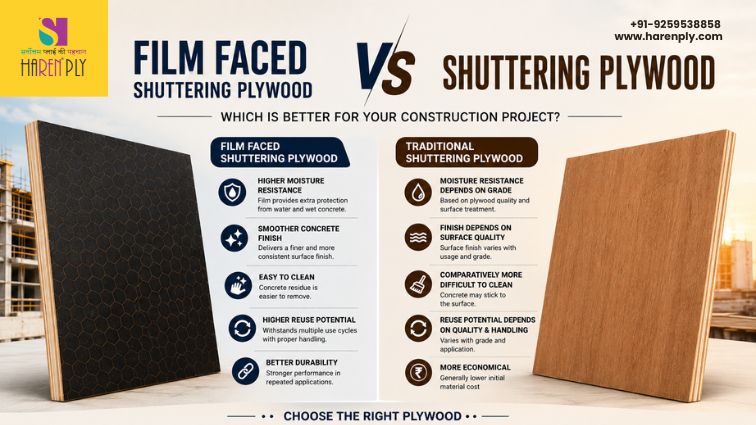
The quality of the shuttering material has a direct impact on the finish, precision, durability, and efficiency of concrete construction. Film faced shuttering plywood and normal shuttering plywood can both be used for making formwork, but they differ in terms of surface treatment, moisture resistance, durability, concrete finish, cleaning, and reuse potential. Understanding these differences through Haren Ply can help contractors, builders, and project owners make the right choice of plywood according to their project requirements. What Is Shuttering Plywood? Formwork or shuttering plywood is specifically manufactured for use in concrete formwork. It provides a rigid and stable surface for forming columns, beams, slabs, and other concrete structures. A good formwork plywood can provide the following advantages: Strength and rigidity Resistance to moisture during concrete work Even and consistent formwork surfaces Good load-bearing performance Easy handling and installation on site The overall performance of shuttering plywood depends on several factors, including plywood thickness, core quality, bonding strength, surface treatment, panel flatness, and manufacturing quality. What Is Film Faced Shuttering Plywood? Film Faced Shuttering Plywood is a formwork plywood with a resin-impregnated protective film bonded to its surface, typically on both sides. The main benefits of the film-faced surface include: Finer concrete finish: The smooth film surface can help produce a smoother and more consistent concrete finish when the panels are properly installed and maintained. Moisture protection: The film provides additional surface protection against moisture and wet concrete during formwork applications. Better durability: Properly manufactured and handled panels can withstand repeated handling and multiple reuse cycles. Easy cleaning: Concrete residues are generally easier to clean from the coated surface. Higher reuse potential: Film-faced panels can offer better reuse potential than conventional shuttering plywood, depending on panel quality, application, handling, and maintenance. Differences Between Film Faced Vs Traditional Shuttering Plywood Features Film Faced Shuttering Plywood Traditional Shuttering Plywood Surface Resin film coated Usually untreated or differently treated Moisture resistance Higher surface protection due to the film Depends on plywood grade, bonding, and surface treatment Concrete finish Generally smoother and more consistent Depends on surface quality and application Durability Better suited for repeated formwork applications Suitable for standard applications, depending on grade and handling Cleaning Easier to clean Comparatively more difficult Reuse Potential Generally higher Depends on quality, application, and handling Initial cost Usually higher Generally more economical Which One Should You Choose? The choice between Film Faced Shuttering Plywood and traditional shuttering plywood should be based on the project’s formwork requirements rather than only on the initial purchase price. Choose Film Faced Shuttering Plywood when: The project involves repeated concrete casting and formwork cycles. A better concrete surface finish is required. Formwork will be exposed to repeated moisture and wet concrete. Contractors want to improve panel durability and reuse potential. Large-scale residential, commercial, or infrastructure construction involves repeated formwork requirements. Choose conventional shuttering plywood when: The project has limited formwork cycles. Initial material cost is a major consideration. The application does not require a specialized film-coated surface. Standard construction requirements can be met with conventional shuttering grades. How to Select a Reliable Shuttering Plywood Manufacturer? Selecting the right Shuttering Ply Manufacturers is as important as choosing the right plywood. Customers should evaluate shuttering plywood based on several important parameters, including: Core quality Uniform thickness Bond strength Surface quality Panel flatness Water resistance Film quality and adhesion, where applicable Edge quality and sealing Expected reuse potential When selecting between Shuttering Plywood Brands, do not make the decision solely on the basis of cost. A lower-cost panel may become more expensive in the long run if it requires frequent replacement, produces inconsistent concrete finishes, or loses performance after limited use. For contractors purchasing in bulk, working directly with established Shuttering Plywood Manufacturers in India can also help ensure consistency in specifications, product quality, and supply. Why Haren Ply? Haren Ply focuses on manufacturing plywood products designed to meet construction requirements in terms of quality, reliability, and performance. When considering formwork suppliers, choosing a manufacturer that maintains consistent production and quality-control standards can help support better productivity and reliable project execution. Haren Ply’s product and quality communication also emphasizes commitment to quality, manufacturing checks, durability, and product performance. Best Shuttering Plywood Manufacturer/ Brand/ Supplier – Haren Ply The use of both shuttering ply and Film Faced Shuttering Ply can be suitable for construction applications, depending on the project’s requirements. Film Faced Shuttering Ply offered by Haren Ply provides the advantages associated with a protective film surface, including improved surface protection, moisture resistance, concrete surface quality, durability, and reuse potential. For large and complex projects involving repeated formwork cycles, the higher initial investment in Film Faced Shuttering Plywood can be justified by its potential for better durability, easier cleaning, improved surface performance, and repeated use. The final choice should always be based on the project’s formwork requirements, expected number of reuse cycles, required concrete finish, moisture exposure, plywood specifications, handling practices, and overall project economics.

Shuttering Plywood
Shuttering Plywood

How Many Times Can Shuttering Plywood Be Reused?

Shuttering plywood is essential in modern construction as it serves as a temporary form for casting concrete. Whether you are building residential properties, commercial structures, or infrastructure projects, one common question is: How many times can be shuttering plywood be reused? The answer depends on multiple factors, such as the plywood’s grade, manufacturing process, on-site handling, and maintenance. Choosing high-quality products from a reliable shuttering plywood manufacturer like Haren Ply can greatly enhance the number of reuse cycles while reducing overall construction expenses. What Determines the Reusability of Shuttering Plywood? The lifespan of shuttering plywood is not fixed. Instead, it depends on how well the plywood is manufactured and maintained throughout its use. Some of the key factors include: Quality of hardwood veneers used Type of waterproof adhesives Surface film coating quality Thickness and density of the plywood Proper cleaning after each use Storage in a dry and shaded environment Careful handling during installation & dismantling When these factors are optimized, shuttering plywood delivers excellent durability and a consistent concrete finish. Average Reuse Capacity This provides a general estimate of the reuse cycles. Shuttering Plywood Quality Expected Reuse Cycle Standard Quality 10–20 times Premium BWP Grade 25–40 times High-Density Film Faced Shuttering Plywood 40–50 times Actual performance may vary depending on construction practices and site conditions. Durable products provided by trustworthy shuttering plywood manufacturers are designed to withstand constant exposure to moisture, stress, and concrete while delivering enhanced value throughout the project’s duration. Tips to Increase the Number of Reuses Proper maintenance can considerably enhance the lifespan of shuttering plywood. Clean After Every Use: Remove concrete residue immediately after disassembly with a plastic scraper or soft brush. Avoid using sharp tools that may damage the surface. Use Release Oil: Applying shuttering oil before concrete pouring prevents concrete from sticking to the plywood, making cleaning easier and reducing surface damage. Protect the Edges: The edges are more prone to absorbing moisture. Using edge sealants when needed helps preserve structural stability. Store Properly: Place plywood sheets flat in a dry, sheltered area. Protect them from direct sunlight and rain to avoid warping. Handle with Care: Avoid dropping, dragging, or hitting the sheets while transporting and installing them, since physical damage reduces their lifespan. Why Quality Matters More than the Initial Cost? While premium shuttering plywood might come with a higher initial cost, it frequently ends up being more affordable in the long run. For Example: A lower-grade plywood reused 15 times costs significantly more per use. A premium sheet reused 45–50 times significantly reduces the cost per concrete cast while ensuring a better surface finish. Investing in high-quality plywood is a wiser choice for contractors, builders, and developers involved in numerous projects. How to Know When Shuttering Plywood Should Be Replaced? Even the best shuttering plywood can only be reused a limited number of times. Consider replacing the sheet if you notice: Deep cracks or splits Delamination between veneer layers Excessive swelling due to moisture Warped or bent sheets Poor concrete surface finish Loose edges or broken corners Replacing damaged sheets at the right time helps maintain construction quality and site safety. Why Choose Haren Ply? Haren Ply is a leading Shuttering Plywood Manufacturer that provides plywood designed for strength, durability, and reliable performance in challenging construction sites. With advanced manufacturing technology and strict quality control, we offer: High-strength hardwood shuttering plywood Excellent load-bearing capacity Superior waterproof bonding Multiple reuse cycles Smooth concrete surface Reliable performance for residential, commercial and infrastructure projects Whether you are managing a small construction project or a large-scale development project, our products are designed to maximize efficiency and reduce long-term project costs. Best Shuttering Plywood Manufacturers – Haren Ply The quality, maintenance, and handling of shuttering plywood determine its reusability. Purchasing high-quality products from reliable Shuttering Plywood Manufacturers ensures increased reuse cycles, reduced construction expenses, and improved concrete surfaces. By following proper maintenance practices, contractors can enhance the durability of shuttering plywood while boosting project efficiency and overall value. Frequently Asked Questions How many times can good-quality shuttering plywood be reused? Premium shuttering plywood can typically be reused between 40 and 50 times when properly maintained. Does waterproof plywood last longer for shuttering? Yes. Shuttering plywood manufactured with high-quality phenolic resin and waterproof bonding offers better moisture resistance and a longer service life. How can I increase the lifespan of shuttering plywood? Clean it after every use, apply release oil, protect the edges, store it in a dry place, and avoid rough handling. Why should I choose experienced shuttering plywood manufacturers? Reliable shuttering plywood manufacturers ensure superior raw materials, stronger bonding, consistent quality, and higher reuse cycles, resulting in better long-term value.

Best Plywood & Laminate Manufacturers
Laminate, Plywood

Best Plywood & Laminate Manufacturers in India for Home & Commercial Interior

Choosing the right plywood or laminate is one of the most important decisions when designing a house or business space. It’s because of the role that these products play in terms of their effect on durability and performance in modular kitchen, wardrobe, and office and retail settings. Collaborating with reliable plywood manufacturers & laminate manufacturer ensures exceptional strength, appealing finish & reliable quality. Haren ply provides a wide range of high-quality plywood & laminates customized to fulfill the needs of modern residential & commercial spaces. Why Plywood is best for Commercial Interiors? Commercial areas undergo the frequent use, which makes durability a high priority. The premium plywood offers: Excellent load-bearing capacity Superior screw holding strength Resistance to warping & bending Moisture & termite resistance Long service life with less maintenance Whether its office furniture, hotels, educational institutions or retail stores, a premium plywood delivers long-lasting performance while supporting elegant interior designs. Types Plywood & Laminate Used in Home & Commercial Interior: Common types of plywood: BWR grade plywood: Suitable for kitchens, utility areas and semi-moist environments where occasional water exposure is expected. BWP (Boiling Water Proof) Marine Grade Plywood: Recommended for bathrooms, commercial kitchens and areas with continuous moisture exposure. MR grade plywood: Perfect for wardrobes, bedroom furniture & dry interiors. Calibrated plywood: Preferred for modular furniture because of its uniform thickness. Common types of laminates: Matte finish laminates High gloss laminates Textured laminates Wood grain laminates Decorative laminates Solid color laminates Which Plywood Works Best for Home & Commercial Interiors? The perfect plywood depends on the application. Home Interior Commercial Interior MR grade plywood – wardrobe, beds & furniture BWP or marine plywood –kitchens & bathroom BWP marine plywood and calibrated plywood Key Specification of Plywood for Home & Commercial Interiors: When you are selecting the plywood manufacturer, consider these following factors: High-density hardwood core BIS/ISI-certified quality (as per applicable Indian Standards) Appropriate moisture resistance according to plywood grade (MR, BWR or BWP) Termite & borer protection Strong bonding using premium adhesives Smooth surface for better laminate application Excellent dimensional stability These features ensures reliable performance across residential & commercial projects. Additional Technical Features: • Core gap-free construction • High-density hardwood core • Excellent bonding strength • Calibrated thickness for modular furniture Key Specification of Laminates for Home & Commercial Interiors: The quality laminate should offer: High abrasion & scratch resistance surface Heat & stain resistance Easy cleaning & maintenance Fade-resistant colors Wide variety of textures & finish Durable decorative layer Long lasting surface protection Tips for Choosing the Best Plywood & Laminate: Before making the purchase of plywood & laminate from a manufacturer, keep these points in mind: Buy from the trusted plywood manufacturer & laminate manufacturer Choose the plywood grade according to the installation area Verify ISI certification & product quality standards Select laminate that match interior theme & use Consider moisture resistance for bathroom & kitchens Balance quality, durability and budget instead only focusing on price Look for manufacturers warranties & after sales support Best Plywood & Laminate Manufacturer – Haren Ply: It is very important to select good-quality plywood and laminates while designing the interiors to give them an appealing as well as lasting look. Choosing a good plywood manufacturer and laminate manufacturer like Haren Ply will ensure the selection of the right quality, which is both durable and elegant. Frequently Asked Questions: What type of plywood is ideal for interior usage? BWR plywood is ideal for kitchen use, while MR plywood suits bedroom, wardrobe and other dry rooms. Marine Grade (BWP) plywood is recommended for applications involving continuous moisture or water exposure. How do I select the appropriate laminate for my furniture? Select laminates according to the use of furniture, durability needs, finishing and interior style. Why should I purchase plywood from the reputed manufacturer? A reputable manufacturer supplies certified products with greater strength, moisture resistance, termite resistance & quality.

Why Interior Designers Prefer Calibrated Plywood for Modern Interiors
Calibrated Plywood

Why Interior Designers Prefer Calibrated Plywood

When designing modern homes, offices, hotels, and retail spaces, precision is just as important as aesthetics. Interior designers not only focus on beautiful designs but also choose materials that deliver consistency, durability, and a flawless finish. This is why professionals prefer products from a trusted calibrated plywood manufacturer. Unlike conventional plywood, calibrated plywood is manufactured using advanced calibration technology that ensures every sheet has uniform thickness. This results in smoother surfaces, stronger furniture, better laminate bonding, reduced material wastage, and faster installation, making it an ideal choice for modern interior projects. What is Calibrated Plywood? Calibrated plywood is manufactured using advanced sanding and calibration machines that ensure uniform thickness across every sheet. This precision manufacturing process eliminates uneven surfaces and provides a smooth finish, making it easier for carpenters, architects, and interior designers to achieve high-quality workmanship. Calibrated plywood is widely used in: Modular kitchens Wardrobes Office furniture Luxury interiors Wall paneling Premium residential and commercial furniture Why Interior Designers Choose Calibrated Plywood 1. Uniform Thickness for a Perfect Finish One of the biggest advantages of calibrated plywood is its consistent thickness. This ensures: Better edge alignment Accurate furniture assembly Smooth installation Professional-quality finishing Designers can confidently create complex furniture designs without worrying about uneven surfaces or thickness variations. 2. Superior Laminate Bonding Calibrated plywood provides a perfectly smooth base for laminates and veneers. Its even surface improves adhesive bonding, reducing the chances of bubbles, peeling, or surface defects. This is particularly important in premium residential and commercial projects where flawless aesthetics are essential. 3. Greater Dimensional Stability High-quality calibrated plywood is less prone to warping, twisting, or bending than ordinary plywood. It maintains its shape even under changing temperature and humidity conditions. Whether used in modular kitchens, wardrobes, or office workstations, calibrated plywood offers long-lasting durability and reliable performance. 4. Faster Installation with Less Rework Since every sheet has consistent dimensions, carpenters spend less time adjusting or correcting thickness variations. Benefits include: Faster furniture manufacturing Reduced labor costs Less material wastage Better project timelines This ultimately helps interior designer’s complete projects more efficiently. Calibrated Plywood vs. Regular Plywood Feature Calibrated Plywood Regular Plywood Thickness Uniform throughout May vary Surface Finish Smooth and even Can be uneven Laminate Bonding Excellent Average Furniture Accuracy High Moderate Material Wastage Low High Installation Time Faster Requires more adjustments Why Choosing a Reliable Calibrated Plywood Manufacturer Matters? Not all plywood manufacturers follow the same quality standards. A reliable calibrated plywood manufacturer invests in advanced production technology, strict quality control, and premium raw materials to ensure consistent product quality. When selecting a manufacturer, look for: Advanced calibration technology Premium hardwood core Moisture and termite resistance Industry certifications Consistent product quality Proven manufacturing expertise Choosing the right manufacturer ensures better performance, longer durability, and higher customer satisfaction. Why Choose Haren Ply? Haren Ply is committed to delivering premium plywood solutions that meet the expectations of architects, interior designers, contractors, and homeowners. With advanced manufacturing processes and strict quality standards, Haren Ply offers: Precisely calibrated plywood Excellent strength and durability Smooth surfaces for superior laminate applications Consistent quality across every sheet Reliable solutions for residential and commercial interiors Conclusion Interior designers prefer calibrated plywood because of its precision, durability, dimensional stability, and superior finish. Its uniform thickness, excellent laminate bonding, and faster installation make it the preferred choice for modern furniture and interior applications. Partnering with a trusted calibrated plywood manufacturer like Haren Ply ensures superior-quality furniture, long-lasting performance, and beautiful interior spaces that stand the test of time. Frequently Asked Questions (FAQs) 1. What is calibrated plywood? Calibrated plywood is an engineered plywood with uniform thickness throughout every sheet. It offers better finishing, improved furniture accuracy, and superior laminate adhesion. 2. Why do interior designers prefer calibrated plywood? Interior designers prefer calibrated plywood because it provides consistent thickness, smooth surfaces, faster installation, reduced material wastage, and premium aesthetic results. 3. Is calibrated plywood suitable for modular furniture? Yes. Calibrated plywood is widely used for modular kitchens, wardrobes, office furniture, and customized interior applications because of its dimensional accuracy and smooth finish. 4. Can calibrated plywood be used for commercial interiors? Absolutely. It is an ideal choice for offices, hotels, retail stores, educational institutions, and other commercial projects that require durable, accurately engineered furniture and premium-quality finishes.

Scroll to Top

Enquire Now